Research Summary
My current research mainly focused on biomedical electronics, microfluidics, lab-on-chip devices, biosensors, wearable and flexible electronics, and the implementation of machine learning and deep learning in healthcare applications. More specifically, my primary research is focused on developing smart healthcare platform for health monitoring, early disease diagnosis, prognosis, and disease treatment.
The main techniques used in our lab include dielectrophoresis (DEP), micro-farbication, electrical impedance spectroscopy (EIS), microfluidic simulation, and machine learning/ deep learning (ML/DL).
Major Research Directions
Impedance Flow Cytometry Based Biomaker Detection
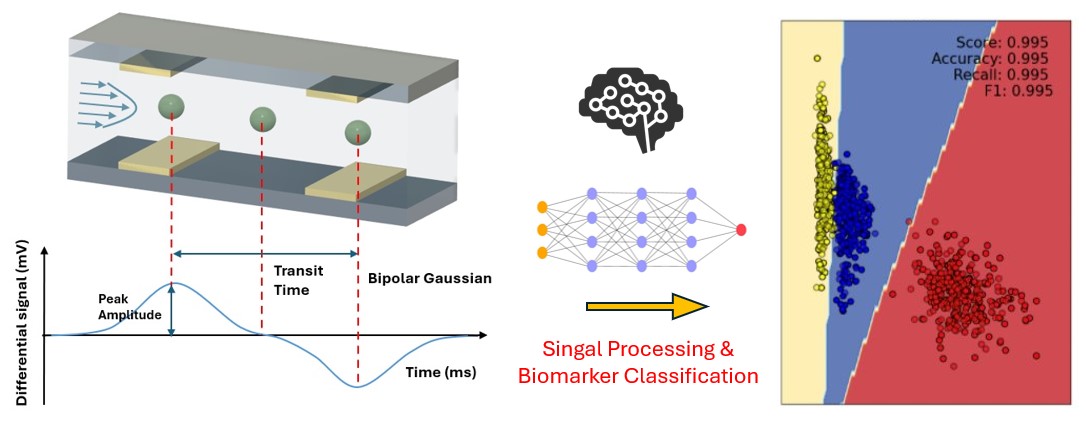
This project focuses on a microfluidic-based system for biomarker detection and classification using signal processing and machine learning techniques. The microfluidic device enables precise measurement of transient electrical signals (differential signal in mV) as biomarkers, such as cells or particles, flow through the channel. As particles pass between electrodes, they produce a bipolar Gaussian signal with distinct peak amplitude and transit time, reflecting their biophysical properties.
The detected signal undergoes advanced processing to extract key features related to each biomarker's characteristics. These features are then used for classification, leveraging a neural network to distinguish between different types of biomarkers. This setup offers a powerful approach for rapid, label-free biomarker classification, with potential applications in diagnostics, particularly in the context of disease markers.
Exosome Characterization and Subtype Classification

This project aims to develop a microfluidic platform for identifying and classifying exosome subtypes, which are small nano-vesicles released by almost all types of cells and have potential as disease markers. The process starts by adding exosome samples into a specialized device that uses electric fields to arrange them for measurement. This setup allows for precise measurement of the particles’ unique dielectric properties, creating data that can reveal important characteristics.
Using this data, a machine learning model is trained to recognize different exosome types, helping to classify them accurately. This innovative system offers a fast, efficient way to analyze exosomes without needing additional labels or markers, paving the way for early disease detection and more personalized healthcare approaches.
Wearable Sensors

This research focuses on developing next-generation wearable and flexible sensor systems capable of continuously tracking key physiological and biochemical indicators. Advances in materials science, microfabrication, and biosensing now allow sensors to be integrated directly into soft and conformal platforms, enabling comfortable long-term health monitoring.
Our goal is to create multi-modal wearable devices that combine mechanical, electrical, optical, and chemical sensing on a single platform. By capturing diverse types of physiological information simultaneously, these systems can provide a more complete picture of an individual’s health state. The integration of real-time data analytics further supports early detection of abnormalities, personalized health insights, and improved management of chronic conditions.